1. Comprehensive Evolution of Artificial Intelligence and Machine Learning Infrastructure
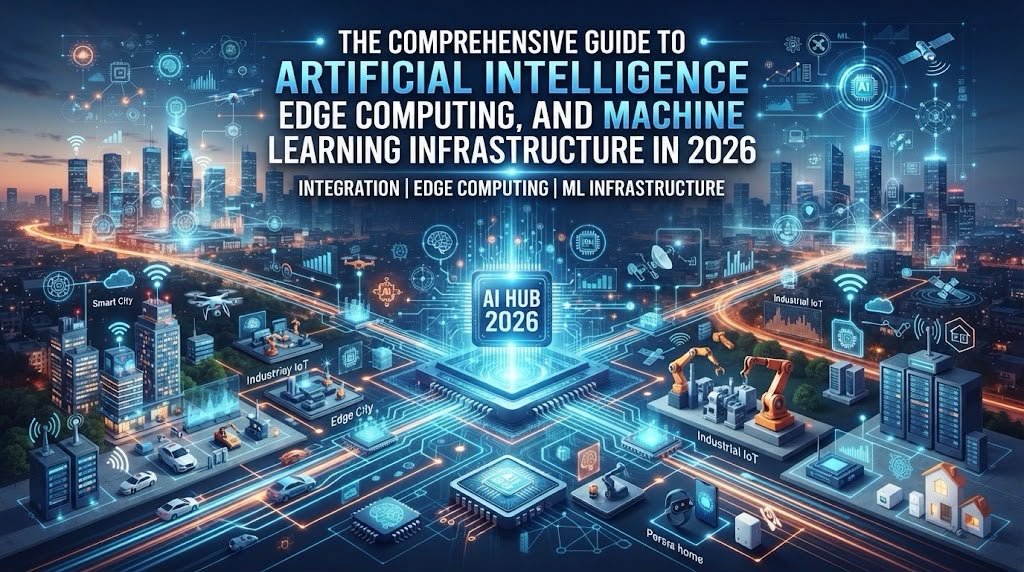
The technological landscape of 2026 marks a profound maturation in how artificial intelligence and machine learning are deployed across enterprise and consumer infrastructure. Moving far beyond the experimental cloud-based chat models of the early 2020s, AI is now an integrated, foundational utility powering everything from industrial robotics to consumer smartphones. Engineers and tech architects operating on Bytewisehub.site recognize that supporting modern AI workloads requires an entirely new paradigm of infrastructure—one that harmonizes high-throughput data pipelines, specialized neural processing hardware, and energy-efficient distributed computing clusters. This evolution is driven by exponential leaps in algorithmic design, hardware acceleration, and the urgent necessity to process massive streams of multi-modal data in real time.
The Strategic Shift Toward Specialized Neural Hardware and Silicon Diversity
Historically, machine learning model training and inference relied exclusively on general-purpose graphics processing units (GPUs). Today, the hardware ecosystem has diversified extensively with the introduction of Application-Specific Integrated Circuits (ASICs), Field Programmable Gate Arrays (FPGAs), and dedicated Neural Processing Units (NPUs) built directly into consumer and server silicon. These specialized processors optimize tensor algebra, matrix multiplications, and quantization algorithms, reducing power consumption while accelerating model training speeds by orders of magnitude.
Balancing Massive Foundation Models with Efficient Edge Execution
While hyperscale data centers continue to train colossal foundation models with trillions of parameters, the practical deployment strategy has bifurcated. This hybrid infrastructure ensures low latency, absolute data privacy, and continuous operation even in intermittent network environments.
2. Edge AI and On-Device Intelligence: Revolutionizing Local Computing
The traditional model of routing every user prompt or sensor reading back to a centralized cloud server introduces unacceptable latency and privacy vulnerabilities. Edge AI brings computation directly to the local device.
Leveraging Neural Processing Units (NPUs) for Local Inference
Modern smartphones, IoT appliances, automotive computers, and industrial sensors now feature integrated Neural Processing Units capable of running complex machine learning inferences locally. By offloading facial recognition, predictive text, real-time speech translation, and sensor data filtering to on-device NPUs, applications achieve zero network latency and conserve vital battery power.
Absolute Data Privacy and Zero-Network Operational Resilience
Processing sensitive medical, financial, or personal data locally at the edge guarantees absolute user privacy since raw data never leaves the device’s secure enclave. Furthermore, edge AI models ensure uninterrupted operational resilience for autonomous vehicles, remote medical devices, and smart manufacturing lines during total internet connectivity outages.
3. Machine Learning Operations (MLOps): Streamlining the Model Lifecycle
Building a high-performing machine learning model is only the first step; managing its lifecycle reliably in production requires rigorous MLOps methodologies.
Automated Data Pipelines and Feature Store Architecture
MLOps bridges the gap between data science and software engineering by introducing automated CI/CD pipelines specifically tailored for machine learning. Centralized feature stores ensure that consistent, validated data features are shared seamlessly between training environments and live production inference endpoints, eliminating data skew and model degradation over time.
Model Monitoring, Drift Detection, and Automated Retraining Loops
Production machine learning models are highly susceptible to data drift and concept drift as real-world patterns change. Automated MLOps platforms continuously monitor model accuracy, latency, and input feature distributions in real time. When performance metrics dip below a predefined threshold, automated retraining pipelines ingest fresh data and trigger seamless model rollouts without disrupting live users.
4. Generative AI and Retrieval-Augmented Generation (RAG) Architecture in Enterprise
Generative artificial intelligence has become a core enterprise engine, but raw foundation models often lack context regarding proprietary company data or real-time information.
Implementing Robust Retrieval-Augmented Generation (RAG) Pipelines
To overcome model hallucination and lack of internal knowledge, enterprise architectures rely heavily on Retrieval-Augmented Generation (RAG). When a user submits a prompt, the system queries a high-performance vector database to retrieve relevant internal documents, customer records,
Vector Databases and High-Dimensional Semantic Indexing
Vector databases have emerged as an indispensable component of modern AI infrastructure. By converting text, images, and audio into high-dimensional numerical embeddings, vector databases enable lightning-fast semantic similarity searches, allowing enterprise applications to unearth relevant information across terabytes of unstructured data instantly.
5. Ethical AI, Algorithmic Transparency, and Responsible Governance
With profound computational power comes profound societal responsibility. The deployment of AI systems in 2026 is governed by strict regulatory frameworks and ethical guidelines.
Auditing Training Corpora and Mitigating Algorithmic Bias
Machine learning models trained on historical human data often inherit historical prejudices and systemic biases. Responsible AI engineering requires rigorous auditing of training corpora, implementing fairness constraints during model optimization, and utilizing explainable AI (XAI) techniques to decode black-box decision-making in high-stakes fields like healthcare, finance, and criminal justice.
Compliance with Global AI Regulations and Data Provenance Tracing
Enterprises must comply with evolving global AI regulations that mandate verifiable data provenance tracking, transparent model disclosure, and strict user consent mechanisms. Documenting every phase of the AI supply chain—from raw data collection to model fine-tuning—ensures full regulatory compliance and protects brand integrity.
6. Quantum Machine Learning (QML): The Next Frontier of Computation
The intersection of quantum computing and artificial intelligence represents one of the most exciting theoretical and practical frontiers of modern technology.
Harnessing Superposition and Entanglement for Complex Matrix Optimization
Quantum processors leverage the principles of quantum mechanics—superposition and entanglement—to evaluate massive parameter spaces simultaneously. When applied to machine learning, QML algorithms can solve high-dimensional optimization problems, molecular simulations, and cryptographic analyses exponentially faster than classical silicon architecture.
Practical Enterprise Applications in Material Science and Drug Discovery
While still in its commercial infancy, Quantum Machine Learning is already accelerating pharmaceutical drug discovery pipelines from decades to months by simulating complex molecular protein folding with absolute fidelity. Similarly, global logistics and energy grid management systems benefit immensely from quantum-enhanced optimization algorithms.
7. Sustainable AI: Green Computing and Energy-Efficient Infrastructure
The staggering electricity demands of training and operating massive neural networks have made sustainability a paramount engineering metric.
Neuromorphic Computing and Biological Brain Efficiency
Semiconductor researchers are pioneering neuromorphic chips that mimic the architecture and extreme energy efficiency of the human biological brain. These asynchronous, event-driven processors consume a fraction of the power required by legacy GPUs, paving the way for sustainable, large-scale AI deployments.
Carbon-Aware Scheduling and Renewable Microgrid Data Centers
Hyperscale cloud data centers housing AI training clusters are increasingly powered by dedicated renewable energy microgrids. Furthermore, advanced orchestration software features carbon-aware scheduling, automatically migrating heavy training workloads to geographic regions and time windows where solar and wind energy generation peaks.
8. Autonomous Systems, Robotics, and Vision-Language-Action Models
Robotics has broken free from the rigid, pre-programmed environments of traditional industrial assembly lines, powered by advanced artificial intelligence.
Foundational Vision-Language-Action (VLA) Models in Physical Robotics
Modern robots are no longer programmed with explicit line-by-line instructions; instead, they are powered by foundational Vision-Language-Action models. These models allow robots to understand unstructured human spoken commands, perceive physical obstacles through spatial computer vision, and execute dexterous manipulation tasks in unpredictable real-world environments.
Transforming Logistics, Autonomous Delivery, and Smart Infrastructure
From autonomous delivery drones navigating crowded urban sidewalks to automated agricultural harvesters picking ripe crops with delicate precision, AI-driven physical automation is revolutionizing supply chain management, warehousing logistics, and municipal infrastructure maintenance.
9. Synthetic Data Generation: Overcoming Training Data Scarcity
One of the most persistent bottlenecks in early machine learning development was the absolute reliance on massive pools of human-generated training data.
Manufacturing High-Fidelity Privacy-Compliant Synthetic Datasets
Using advanced simulation engines and generative diffusion models, researchers can now manufacture infinite, high-fidelity synthetic datasets. This innovation solves data scarcity challenges for rare medical diseases, autonomous driving edge cases, and secure financial fraud detection without compromising individual privacy rights.
Eliminating Bias through Controlled Data Balancing
Synthetic data generation allows engineers to deliberately manufacture balanced edge cases and underrepresented demographics into training corpora, effectively eliminating historical data biases and producing more robust, fair machine learning models.
10. Edge-to-Cloud Distributed Intelligence Architecture
Modern enterprise applications no longer rely on a binary choice between isolated edge processing and centralized cloud infrastructure; instead, they utilize seamless distributed intelligence architectures.
Hybrid Orchestration of Local and Cloud Workloads
Lightweight local models on user devices handle immediate, latency-sensitive tasks, while heavier analytical workloads, long-term memory consolidation, and multi-agent coordination are dynamically offloaded to elastic cloud clusters. This hybrid orchestration ensures optimal performance, cost efficiency, and uninterrupted operational resilience.
Comparison of Modern AI Paradigms and Infrastructure Models
| AI Paradigm / Architecture | Primary Use Case | Key Operational Advantage | Typical Infrastructure Target |
| Edge AI & On-Device SLMs | Real-time response, local tasks | Zero latency, absolute data privacy | Mobile NPUs, IoT silicon, Edge gateways |
| Enterprise RAG Pipelines | Proprietary knowledge retrieval | Eliminates hallucination, real-time context | Vector databases, Cloud LLM endpoints |
| MLOps Automated Pipelines | Model lifecycle management | Prevents data drift, automated retraining | Kubernetes clusters, Feature stores |
| Quantum Machine Learning | Complex molecular simulation | Exponential speedup in optimization | Quantum processors, Hybrid QPU-CPUs |
11. Advanced Multi-Agent Autonomous Systems and Collaborative AI Workflows in Enterprise Operations
As artificial intelligence architectures mature, the industry has shifted away from isolated, single-purpose prompt models toward collaborative Multi-Agent Systems. In this paradigm, distinct AI agents—each specialized in a specific domain such as code compilation, security auditing, database management, or UI design—communicate with one another autonomously to accomplish high-level organizational objectives. Instead of a human manually orchestrating every step of a workflow, an orchestrator agent breaks down a complex corporate project into discrete tasks, assigns them to specialized peer agents, reviews their outputs for errors, and synthesizes the final result. This collaborative multi-agent orchestration revolutionizes software development pipelines, financial forecasting, and automated supply chain logistics by introducing dynamic, self-correcting cognitive loops into business operations.
Autonomous Task Planning and Cross-Agent Negotiation Protocols
Modern multi-agent systems rely on advanced planning algorithms and structured communication protocols. When presented with a complex objective—such as auditing an enterprise codebase, fixing vulnerabilities, and writing deployment documentation—the lead agent negotiates sub-tasks with specialized worker agents. If a security agent detects a flaw in code generated by a coding agent, it transmits structured feedback, prompting the coding agent to rewrite the routine automatically. This continuous peer-review loop drastically reduces human oversight requirements and accelerates enterprise task execution speed.
12. Generative Biology, AlphaFold Evolution, and AI-Driven Drug Discovery Pipelines
The profound convergence of artificial intelligence and molecular biology has completely revolutionized the pharmaceutical and healthcare industries. Building upon foundational breakthroughs in protein structure prediction, modern generative biology models can simulate complex molecular interactions, predict enzymatic activity, and design entirely novel synthetic proteins from scratch. By analyzing genomic data, metabolic profiles, and chemical libraries within hyper-dimensional latent spaces, AI systems shorten drug discovery pipelines from decades to mere months. Pharmaceutical researchers can now identify viable drug candidates, test their pharmacological efficacy in silico, and optimize chemical structures for targeted gene therapies with unprecedented precision.
Simulating Molecular Dynamics and Precision Target Identification
Traditional drug discovery involved trial-and-error laboratory experimentation that was exceptionally slow and expensive. Modern AI infrastructure uses deep learning models to simulate molecular dynamics at the atomic level. These systems predict how candidate drug molecules bind to specific disease proteins, mapping out potential side effects and metabolic pathways before a single physical test tube is ever touched in a wet laboratory.
13. AI Model Compression, Quantization, and Knowledge Distillation Techniques
Deploying massive foundation models with hundreds of billions of parameters requires exorbitant cloud computing budgets and immense electrical power. To democratize access and enable deployment on standard consumer hardware, modern AI engineers rely heavily on sophisticated model compression techniques, including Quantization and Knowledge Distillation. Quantization converts high-precision 32-bit floating-point weights into lower-precision formats (such as 8-bit or 4-bit integers), drastically shrinking model file sizes and accelerating inference speeds with negligible loss in accuracy. Simultaneously, knowledge distillation trains smaller, nimble “student” models to mimic the rich behavioral outputs of massive “teacher” models, producing highly efficient neural networks tailored for edge devices.
Achieving High-Speed Local Inference via Post-Training Quantization (PTQ)
Post-Training Quantization (PTQ) allows developers to optimize pre-trained foundation models without retraining them from scratch. By mapping continuous weight distributions into discrete quantized buckets, memory bandwidth requirements are cut down significantly. This breakthrough enables developers to run powerful natural language processing and computer vision models directly on resource-constrained edge hardware, smartphones, and local micro-servers.
14. Explainable AI (XAI) and Algorithmic Auditing in High-Stakes Decision Systems
As machine learning models take on increasingly critical roles in high-stakes fields—such as clinical medical diagnoses, financial loan approvals, criminal justice risk assessments, and autonomous flight control—the traditional “black-box” nature of deep neural networks becomes a severe liability. Explainable AI (XAI) addresses this challenge by introducing interpretability layers that decode how a model arrives at a specific decision. Using attribution methods, feature importance scoring, and counterfactual analysis, XAI frameworks provide human operators with clear, auditable rationales for every automated prediction, ensuring accountability, transparency, and legal compliance.
Unlocking Black-Box Neural Networks with Feature Attribution Methods
Explainable AI tools utilize advanced mathematical attribution techniques—such as SHAP (Shapley Additive exPlanations) and LIME (Local Interpretable Model-agnostic Explanations)—to highlight exactly which input variables influenced a model’s output. If a medical AI diagnoses a pulmonary condition, the XAI framework visually outlines the specific anatomical regions in the radiological scan that triggered the diagnosis, enabling human doctors to verify the algorithmic reasoning before administering treatment.
15. The Convergence of Neuromorphic Computing and Edge Neural Silicon
To sustain the exponential growth of artificial intelligence without overwhelming global energy grids, semiconductor engineering is undergoing a fundamental architectural pivot toward Neuromorphic Computing. Unlike traditional von Neumann computing architectures that separate processing and memory units—causing severe energy bottlenecks during data transfer—neuromorphic chips mimic the biological structure and event-driven processing of the human brain. These specialized neural silicon processors process data only when changes occur (spiking neural networks), consuming a minuscule fraction of the electrical power required by traditional GPUs and opening the door for perpetual, autonomous AI agents operating on remote edge hardware.
Event-Driven Spiking Neural Networks (SNNs) and Ultra-Low Power Consumption
Neuromorphic processors utilize Spiking Neural Networks (SNNs) that communicate via discrete electrical impulses akin to biological neurons. This event-driven design means that when there is no incoming sensory data or task execution required, the processor drops into an ultra-low idle state consuming nearly zero power. This capability is vital for powering continuous environmental monitoring sensors, autonomous micro-drones, and implanted medical devices for months on a single battery charge.
Frequently Asked Questions (FAQs)
Q1: What is the primary function of Multi-Agent Autonomous Systems in enterprise AI?
A: Multi-agent systems utilize specialized AI agents (such as coding, auditing, and management agents) that communicate and collaborate autonomously to break down and execute complex corporate workflows with minimal human oversight.
Q2: How does Retrieval-Augmented Generation (RAG) differ from model fine-tuning?
A: While fine-tuning permanently alters a model’s internal weights using new training datasets, RAG dynamically retrieves relevant external documents from a vector database and injects them as context into the prompt at runtime, providing up-to-date, verifiable information without retraining.
Q3: What is model quantization in machine learning infrastructure?
A: Quantization is a compression technique that converts high-precision model weights (like 32-bit floats) into lower-precision integers (like 8-bit or 4-bit), drastically reducing file size and speeding up inference without significant accuracy loss.
Q4: Why is Explainable AI (XAI) crucial in fields like healthcare and finance?
A: XAI decodes the “black-box” nature of neural networks by providing clear, auditable rationales and feature attribution for every automated decision, ensuring accountability, trust, and regulatory compliance in high-stakes environments.
Q5: How do neuromorphic chips achieve extreme energy efficiency?
A: Neuromorphic chips mimic the human biological brain using event-driven Spiking Neural Networks that only consume electricity when active data impulses occur, bypassing traditional memory transfer bottlenecks.
Conclusion: Navigating the Future Horizon of Intelligent Infrastructure
The technological landscape of 2026 clearly demonstrates that artificial intelligence has evolved far beyond basic chat interfaces into a hyper-distributed, multi-agent, and energy-efficient operational bedrock. By mastering multi-agent orchestration, model quantization, explainable AI governance, and neuromorphic computing paradigms, organizations can build intelligent systems that scale securely, respect user privacy, and operate sustainably. At Bytewisehub.site, we remain committed to tracking these monumental technological shifts, empowering our readers with the deep, technical insights required to lead in the era of intelligent infrastructure.