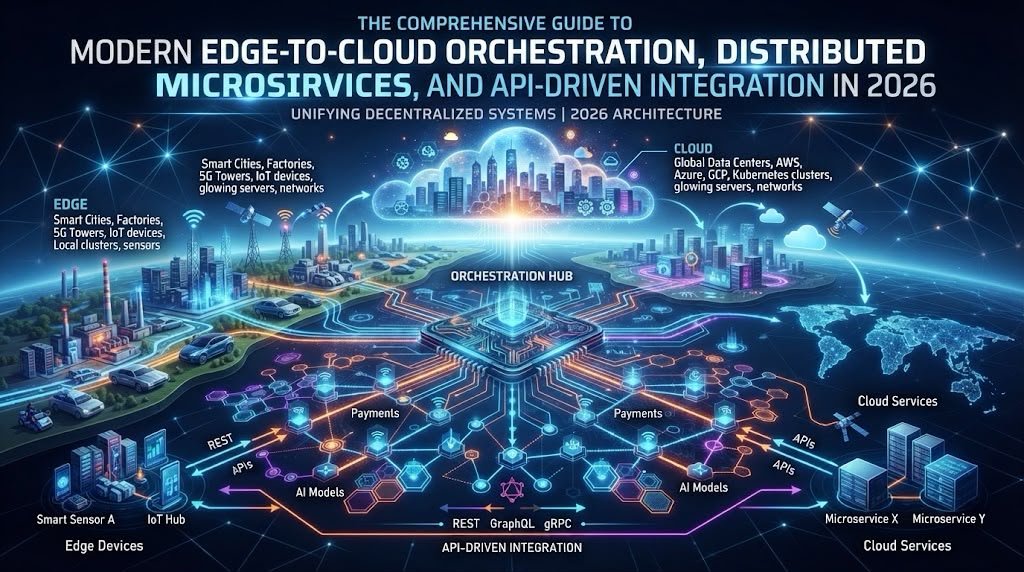
1. Comprehensive Evolution of Distributed Microservices and API-Driven Enterprise Architecture
The architecture of enterprise software has undergone a definitive structural transformation. Moving far beyond the rigid, tightly coupled monolithic applications of the past, modern software engineering in 2026 relies entirely on hyper-distributed microservices, API-first design principles, and seamless edge-to-cloud orchestration platforms. Developers and architects operating on Bytewisehub.site recognize that today’s digital products must handle billions of concurrent transactions, adapt dynamically to regional traffic shifts, and maintain absolute operational resilience even during localized infrastructure failures. This evolution is driven by advances in lightweight container runtimes, automated service meshes, and protocol-driven communications that decouple frontend presentation layers from scalable backend services.
The Strategic Shift Toward Domain-Driven Microservice Decomposition
Historically, applications were constructed as single, massive codebases where a bug in a minor reporting module could crash the entire system. Modern microservices architecture decomposes business capabilities into independent, autonomously deployable services, each owning its specific database and domain logic. This domain-driven design allows specialized engineering teams to build, test, and release feature updates rapidly without risking the stability of unrelated system components.
API-First Design and Contract-Driven Interoperability
In an ecosystem comprising hundreds of independent microservices, clear communication contracts are vital. Modern engineering teams enforce strict API-First Design, mandating that all service-to-service communication protocols, data schemas, and interface contracts are explicitly defined using standards like OpenAPI or AsyncAPI before a single line of backend implementation code is written. This contract-driven workflow enables frontend, mobile, and backend teams to develop concurrently without integration friction.
2. Edge-to-Cloud Orchestration: Bridging Global Proximity with Centralized Power
Modern applications must serve a global user base with ultra-low latency, requiring a sophisticated hybrid infrastructure that bridges edge computing nodes with centralized cloud data centers.
Distributed Execution at Edge Points of Presence (POPs)
Edge computing platforms allow developers to deploy lightweight serverless functions and API routing logic directly to hundreds of data center locations distributed worldwide, mere miles from end users. These edge nodes handle user authentication verification, regional request caching, A/B testing variations, and header manipulation instantly in sub-milliseconds before traffic ever reaches core cloud infrastructure.
Elastic Cloud Offloading for Heavy Computational Workloads
While latency-sensitive tasks are handled at the network edge, heavier analytical workloads, long-term database transactions, and multi-agent coordination are dynamically offloaded to elastic cloud clusters. This hybrid orchestration ensures optimal performance, cost efficiency, and uninterrupted operational resilience across distributed geographic boundaries.
3. Advanced Service Meshes and eBPF-Based Network Observability
As microservice environments expand into thousands of discrete containers, manual network routing, traffic management, and security policy enforcement become completely impossible.
Decoupling Network Management via Service Mesh Tooling
Modern cloud-native networks rely on advanced service meshes like Istio or Linkerd to manage service-to-service communication. The service mesh transparently handles mutual TLS (mTLS) encryption, traffic shifting for canary deployments, automatic retries, and rate limiting, completely decoupling network management logic from application business code.
Kernel-Level Telemetry and Packet Filtering with eBPF
Traditional sidecar proxies introduced noticeable network latency by routing packets through user space. Modern architectures leverage Extended Berkeley Packet Filtering (eBPF) to execute custom bytecode directly inside the Linux kernel. This breakthrough enables ultra-fast packet filtering, advanced load balancing, and deep security observability with minimal CPU overhead.
4. Event-Driven Architectures and Asynchronous Message Brokers
Synchronous request-response communication can create cascading bottlenecks when a downstream service experiences latency. Modern enterprise architectures heavily favor asynchronous, event-driven patterns.
Decoupling Services with Distributed Event Streaming
Event-driven architectures use distributed message brokers and event streaming platforms (such as Apache Kafka and RabbitMQ) to decouple service dependencies. When a state change occurs—such as a user completing a purchase—an event is published to a shared event bus. Interested microservices consume the event asynchronously, updating their own internal databases without blocking the original transaction flow.
Managing Event Sourcing and CQRS Design Patterns
Modern data-intensive microservices frequently implement Command Query Responsibility Segregation (CQRS) combined with Event Sourcing. Instead of updating a static database row, every state change is stored as an immutable sequence of historical events. This pattern provides an absolute audit trail, simplifies debugging, and enables high-performance read models optimized for specific user interfaces.
5. API Gateways, Rate Limiting, and Resilient Traffic Management
API gateways serve as the single secure entry point for all external client requests entering a microservices ecosystem, managing traffic safety and protocol translation.
Protocol Translation: Bridging REST, gRPC, and GraphQL
Modern API gateways handle protocol translation transparently, allowing mobile clients to communicate via REST or GraphQL while internal microservices communicate using high-throughput, low-latency gRPC protocols over HTTP/2.
Circuit Breakers and Rate Limiting
When a microservice begins throwing errors, the circuit breaker trips instantly, failing fast and returning graceful fallback responses rather than overwhelming the struggling service with redundant traffic.
6. Distributed Transactions and the Saga Pattern in Microservices
In a monolithic database, multi-step transactions are easily managed via ACID guarantees. In a distributed microservice environment where each service owns a separate database, traditional two-phase commit (2PC) protocols are too slow and brittle.
Orchestration-Based vs. Choreography-Based Sagas
To maintain data consistency across distributed boundaries without blocking databases, modern architectures implement the Saga Pattern. A Saga is a sequence of local transactions where each service updates its database and publishes an event or message triggering the next step. If a step fails, the Saga executes compensating transactions to undo preceding changes, ensuring eventual consistency across the entire microservice ecosystem.
7. Zero Trust Network Access (ZTNA) and Microservice Security
Securing communication across thousands of distributed microservices requires abandoning traditional network perimeters in favor of strict Zero Trust principles.
Mutual TLS (mTLS) and Cryptographic Service Identities
Every microservice within a distributed cloud environment is assigned a unique cryptographic identity managed by an automated public key infrastructure (PKI). Services authenticate each other continuously using mutual TLS (mTLS) encryption, ensuring that unauthorized or compromised containers cannot access sensitive internal APIs.
Granular Authorization Policies and Token Propagation
API requests carry cryptographically signed tokens containing user permissions and scopes. Microservices validate these tokens locally against security policies, enforcing the principle of least privilege across every tier of the application stack.
8. Observability in Distributed Systems: Metrics, Logs, and Traces
Debugging errors across a complex web of distributed microservices requires holistic observability across the three foundational pillars.
Universal Telemetry Collection with OpenTelemetry
OpenTelemetry has become the universal standard for instrumenting microservices, allowing engineering teams to capture standardized metrics, structured logs, and distributed traces without vendor lock-in. Unified collectors aggregate telemetry data efficiently for real-time visualization and alerting.
Distributed Tracing: Following a Request Across the Entire Mesh
When a user clicks a button, a distributed trace assigns a unique correlation ID to the request. As the request bounces across dozens of microservices, serverless functions, and database queries, the trace records execution times and error states at every hop, enabling engineers to isolate performance bottlenecks instantly.
9. CI/CD Automation and GitOps for Microservice Deployments
Managing deployments for hundreds of independent microservices requires rigorous CI/CD automation and declarative GitOps methodologies.
Declarative State Reconciliation with ArgoCD and Flux
Using GitOps engines, the desired state of every microservice deployment is stored in version-controlled Git repositories. Automated reconciliation engines continuously synchronize production clusters with the Git repository, eliminating manual deployment scripts and providing a crystal-clear audit trail of every change.
Automated Canary Rollouts and Progressive Delivery
To prevent production regressions, CI/CD pipelines automate progressive delivery. New microservice versions are rolled out to a tiny fraction of live user traffic (canary deployment), while automated monitoring systems track error rates and latency before gradually promoting the release to 100% of the user base.
10. Cloud FinOps and Resource Optimization for Distributed Microservices
The flexibility of distributed microservice architectures can easily lead to infrastructure sprawl and runaway cloud bills if resource allocation is left unmonitored.
Right-Sizing Container Pods and Auto-Scaling Policies
FinOps practices integrate engineering and finance teams using real-time cost-allocation dashboards. Kubernetes Horizontal Pod Autoscalers (HPA) and Cluster Autoscalers dynamically scale container instances based on actual CPU and memory utilization, spinning pods down to zero when traffic subsides to eliminate idle waste.
Optimizing Network Egress and Multi-Cloud Data Transfer Costs
Cross-region data transfer fees between cloud availability zones can accumulate rapidly. FinOps optimization strategies configure microservices to prioritize regional data locality, compressing payloads and leveraging internal caching layers to minimize expensive cloud egress expenses.
Comparison of Distributed Architecture Patterns
| Architectural Pattern | Primary Use Case | Key Operational Advantage | Scalability & Performance Profile |
| Service Mesh (Istio/Linkerd) | Microservice security & traffic routing | Transparent mTLS encryption, automated retries | Low overhead, high-throughput proxy management |
| Event-Driven Messaging | Decoupled asynchronous workflows | High resilience, absorbs traffic spikes seamlessly | Massive horizontal scaling via event brokers |
| API Gateway & gRPC | External client entry & internal comms | Protocol translation, ultra-fast binary serialization | Sub-millisecond internal routing efficiency |
| Saga Pattern Transactions | Distributed multi-service workflows | Maintains eventual consistency without 2PC locks | Reliable handling of distributed business logic |
11. Comprehensive Edge-to-Cloud API Gateway Federation, Distributed Routing Policies, and Multi-Region Load Balancing
As global enterprise applications expand their operational footprint across multiple cloud providers and edge networks, managing incoming client traffic requires sophisticated API gateway federation and multi-region load balancing strategies. Modern distributed systems rely on federated API gateways that synchronize routing rules, security policies, and rate-limiting quotas across hundreds of edge points of presence (POPs) worldwide. When a user sends an API request, intelligent edge routers evaluate geographic proximity, network congestion, and regional server health in real time, routing the request to the nearest available cloud region or edge microservice instance with sub-millisecond efficiency. This federated approach ensures absolute high availability and eliminates single points of failure across global digital infrastructures.
Global Anycast Routing and Dynamic Failover Protocols
Global API gateway federation utilizes Border Gateway Protocol (BGP) Anycast routing to direct user traffic to the topologically closest data center. If a regional cloud data center experiences an unexpected outage or severe latency spike, Anycast routing dynamically recalculates network paths, shifting active traffic flows to a secondary cloud region within seconds without dropping user sessions or breaking API contracts.
12. Advanced Circuit Breaking, Fault Isolation, and Cascading Failure Prevention in Microservice Meshes
In complex microservice environments consisting of hundreds of interdependent services, a failure in a single peripheral database or caching layer can trigger a catastrophic cascading collapse across the entire system. To protect against this vulnerability, modern distributed architectures implement advanced circuit breaking patterns, bulkhead isolation, and automated retry budgets. A circuit breaker monitors error rates for every downstream service call; if failures exceed a specific threshold, the circuit trips instantly, failing fast and returning pre-configured fallback responses rather than overwhelming the struggling service with redundant requests. Simultaneously, bulkhead isolation partitions thread pools and memory allocations per service, ensuring that a resource leak in one module cannot starve other critical components of system resources.
Adaptive Exponential Backoff and Jittered Retry Strategies
When downstream network partitions occur, uncoordinated client retries can overwhelm recovering systems with a massive wave of traffic known as the “thundering herd” problem. Modern distributed systems implement adaptive exponential backoff combined with randomized jitter, spacing out retry attempts intelligently to allow recovering microservices to stabilize safely.
13. Declarative GitOps Workflows, Automated Rollbacks, and Progressive Delivery Pipelines
Managing software deployments for hundreds of independent microservices manually is entirely untenable in modern engineering. The industry standard relies heavily on declarative GitOps workflows and progressive delivery pipelines. In a GitOps framework, version-controlled Git repositories serve as the single source of truth for the desired state of all microservice deployments and infrastructure configurations. Automated reconciliation controllers continuously monitor production clusters, comparing the live runtime state with the Git repository and reconciling any deviations automatically. When new microservice versions are merged, progressive delivery pipelines execute canary deployments, routing a small percentage of live traffic to the new version while automated metrics analyzers monitor error rates and latency before promoting the release globally.
Automated Metric-Driven Verification and Instant Rollback Triggers
Progressive delivery tools continuously ingest real-time telemetry from application performance monitors during canary rollouts. If error rates, latency percentiles, or CPU usage exceed baseline safety thresholds, the pipeline automatically aborts the deployment and triggers an instant, automated rollback to the last stable version without human intervention.
14. Secure Service-to-Service Communication, OAuth2 Token Exchange, and Zero Trust Token Propagation
Securing communication across distributed microservices requires abandoning traditional network-level perimeters in favor of strict Zero Trust cryptographic identity frameworks. Every microservice within a cloud-native cluster possesses an automated, short-lived cryptographic certificate managed by an internal public key infrastructure. When an external client makes an authenticated request via an API gateway, the gateway exchanges the user’s credentials for an encrypted JSON Web Token (JWT) or opaque access token. As the request propagates across internal microservices via gRPC or HTTP/2, this security token is securely propagated through context headers. Downstream microservices validate the token cryptographically and enforce granular attribute-based access control (ABAC) policies locally, ensuring that no service trusts another blindly.
Cryptographic Token Introspection and Fine-Grained Scope Validation
Microservices do not rely on implicit trust based on network IP addresses. Instead, every internal service call validates cryptographically signed token claims, checking scopes, issuer identity, and expiration timestamps to ensure that unauthorized containers cannot execute privileged administrative actions.
15. Distributed Tracing Telemetry, OpenTelemetry Collectors, and Real-Time Root Cause Analysis
Debugging performance bottlenecks and error states across a hyper-distributed web of microservices requires comprehensive observability supported by standardized telemetry. OpenTelemetry has established itself as the universal standard for instrumenting microservices, capturing high-resolution metrics, structured logs, and distributed traces without vendor lock-in. Distributed tracing assigns a unique correlation ID to every incoming user request at the API gateway entry point. As the request traverses dozens of microservices, asynchronous message brokers, and database queries, trace spans record exact execution durations, metadata tags, and exception stack traces. Centralized OpenTelemetry collectors aggregate these massive telemetry streams, feeding them into analytical platforms that use machine learning to execute automated root cause analysis during system anomalies.
High-Performance Telemetry Pipelines and Sampling Strategies
Because tracing every single transaction in a high-concurrency enterprise system can generate petabytes of telemetry data, modern observability architectures implement intelligent tail-based and head-based sampling strategies. These strategies capture 100% of anomalous traces and errors while intelligently sampling a representative fraction of normal traffic, balancing observability depth with storage costs.
Frequently Asked Questions (FAQs)
Q1: How do federated API gateways improve multi-region cloud routing?
A: Federated API gateways synchronize routing policies and use Bypassed Anycast routing to direct client traffic to the nearest available cloud region, ensuring high availability and instant failover during regional outages.
Q2: What is the purpose of bulkhead isolation in microservice architectures?
A: Bulkhead isolation partitions thread pools and memory allocations per microservice, ensuring that a resource exhaustion bug or failure in one module cannot spread and crash other parts of the system.
Q3: How do automated GitOps controllers maintain cluster state consistency?
A: GitOps controllers continuously compare the live runtime state of production clusters against version-controlled Git repositories, automatically reconciling any discrepancies to match the desired configuration.
Q4: Why is token propagation critical in Zero Trust microservice security?
A: Token propagation passes cryptographically signed user security context across internal microservice calls, enabling downstream services to validate permissions and enforce strict access controls independently.
Q5: What role do OpenTelemetry collectors play in distributed tracing?
A: OpenTelemetry collectors aggregate massive streams of standardized metrics, logs, and distributed traces from thousands of microservices, enabling real-time visualization and automated root cause analysis.
Conclusion
The comprehensive landscape of modern edge-to-cloud orchestration, distributed microservices, and API-driven integration in 2026 exemplifies the pinnacle of software engineering modularity, resilience, and operational scalability. By mastering federated API gateways, advanced circuit breaking, declarative GitOps workflows, Zero Trust token propagation, and OpenTelemetry observability, modern enterprises can build robust digital ecosystems that scale infinitely while remaining secure and cost-effective. At Bytewisehub.site, we remain dedicated to exploring these advanced architectural methodologies, providing deep technical insights to empower engineers and technology leaders shaping the future of global software engineering