1. Comprehensive Evolution of Modern Data Engineering and Lakehouse Paradigms
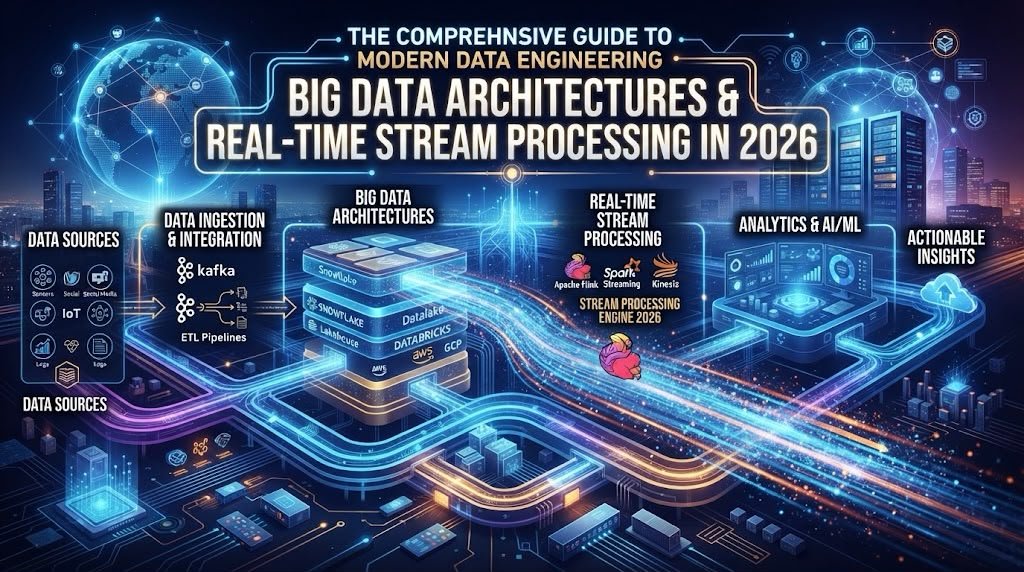
The discipline of data engineering has experienced a massive paradigm shift. Moving far beyond traditional monolithic data warehouses and rigid Hadoop clusters, modern data architecture in 2026 relies on unified Data Lakehouse platforms, real-time stream processing engines, and decentralized data mesh topologies. This evolution enables real-time analytics, machine learning feature engineering, and instantaneous business intelligence reporting at an unprecedented scale.
The Convergence of Data Lakes and Data Warehouses into Lakehouse Architecture
Historically, organizations maintained a complex, fragmented architecture: raw, unstructured data was dumped into cheap data lakes, while clean, structured data was moved separately into expensive data warehouses for business reporting. Modern data engineering has eliminated this friction through open table formats like Apache Iceberg, Delta Lake, and Apache Hudi. These formats bring reliable ACID transactions, time travel, and schema enforcement directly to low-cost cloud object storage, unifying all workloads into a single, high-performance Data Lakehouse.
Decentralized Data Mesh Topologies and Domain-Oriented Ownership
As enterprises scale, centralized data engineering teams often become critical bottlenecks, overwhelmed by disparate requests from every business unit. Data mesh treats data as a first-class product, decentralizing ownership to domain-oriented teams (such as marketing, finance, and logistics).
2. Real-Time Stream Processing: Moving from Batch to Event-Driven Analytics
Traditional batch processing—running heavy ETL jobs overnight—is no longer sufficient for modern enterprises that require instantaneous insights, real-time fraud detection, and live user personalization.
Low-Latency Event Streaming with Apache Kafka and Apache Flink
Modern data pipelines rely heavily on distributed event streaming platforms like Apache Kafka for ingestion and Apache Flink for stateful stream processing. These engines process millions of events per second with sub-second latencies, transforming, enriching, and aggregating streaming data on the fly before it ever lands in permanent storage.
Lambda vs. Kappa Architecture: Simplifying Real-Time Data Pipelines
The industry has largely transitioned from legacy Lambda architectures (which maintained separate batch and streaming pipelines) to the streamlined Kappa architecture. By processing all data—historical and real-time—through a single, unified streaming pipeline, Kappa architecture eliminates data duplication, reduces storage overhead, and ensures absolute consistency between historical analytics and live operational dashboards.
3. Modern Open Table Formats: Apache Iceberg, Delta Lake, and ACID Compliance
The backbone of modern data lakehouse storage relies on open table formats that bring database-grade reliability to massive cloud storage buckets.
Enabling ACID Transactions and Schema Evolution on Cloud Storage
Open table formats like Apache Iceberg and Delta Lake introduce robust metadata layers over raw Parquet or ORC files stored in AWS S3 or Google Cloud Storage. These formats support full ACID (Atomicity, Consistency, Isolation, Durability) transactions, ensuring that concurrent read and write operations never corrupt data tables. Furthermore, they allow seamless schema evolution—allowing data engineers to add, drop, or rename columns safely without breaking downstream analytics queries.
Time Travel, Data Auditing, and Rollback Capabilities
One of the most powerful features of modern open table formats is time travel. Data engineers can query historical snapshots of a dataset as it existed at any exact timestamp or version number. If an erroneous data pipeline corrupts a production table, operators can instantly roll back the table to its last healthy state with a single SQL command, ensuring absolute data integrity and audit compliance.
4. Cloud Data Warehouses and Distributed SQL Query Engines
While lakehouses handle massive unstructured and semi-structured processing, high-performance cloud data warehouses and distributed SQL engines provide lightning-fast analytical query responses.
Decoupled Compute and Storage Architectures
Modern cloud data platforms use decoupled storage and compute architectures.
Vectorization and Pushdown Optimization for Blazing Fast Queries
Distributed SQL query engines leverage advanced vectorization techniques—processing entire batches of data in CPU registers simultaneously—along with predicate pushdown optimization. This ensures that filters and aggregations are executed as close to the storage layer as possible, drastically reducing network I/O and returning complex analytical queries in milliseconds.
5. Data Orchestration, Lineage, and MLOps Data Pipelines
Managing complex dependency graphs across thousands of daily data pipelines requires sophisticated orchestration tools and rigorous metadata management.
Declarative Data Orchestration with Modern Workflow Engines
Modern data teams use advanced code-as-configuration workflow orchestrators to manage complex DAGs (Directed Acyclic Graphs). These engines handle automated retries, cross-system dependency mapping, dynamic task allocation, and alert notifications, ensuring that data pipelines execute reliably across distributed cloud environments.
Automated Data Lineage and Governance Catalogs
Regulatory compliance and data quality assurance require absolute visibility into how data flows from its raw source to its final business report. Automated data lineage tools map every transformation step, providing clear, visual audit trails. Enterprise data catalogs automatically index datasets, track data quality metrics, and enforce privacy policies across the entire data ecosystem.
6. Data Quality, Observability, and Automated Anomaly Detection
Bad data flowing into machine learning models or business dashboards can lead to catastrophic financial decisions. Ensuring data reliability has become a critical data engineering discipline.
Continuous Monitoring of Freshness, Distribution, and Volume
Modern data observability platforms monitor data pipelines continuously for anomalies—such as unexpected drops in data volume, schema changes, null value spikes, or delayed pipeline execution (staleness). Automated alerts notify data engineers instantly before downstream business users are impacted.
Automated Data Testing and Constraint Enforcement
Data pipelines incorporate automated testing frameworks that validate data contracts and assert constraints (such as uniqueness, range checks, and referential integrity) at every transformation stage, treating data pipelines with the same software engineering rigor applied to application codebases.
7. Modern ETL to ELT: Leveraging Cloud Scale for Transformations
The traditional paradigm of Extract, Transform, Load (ETL)—where data was transformed on dedicated legacy servers before loading into a warehouse—has shifted overwhelmingly to ELT (Extract, Load, Transform).
Pushing Heavy Transformations Down to Cloud Storage and Warehouses
In the ELT paradigm, raw data is extracted and loaded directly into high-performance cloud storage or data warehouses immediately. Powerful cloud compute engines then handle the heavy transformation workloads using scalable SQL scripts or distributed dataframes. This approach preserves raw historical data indefinitely and accelerates data ingestion pipelines.
Declarative Transformation Frameworks and Version-Controlled SQL
Data transformation workflows are managed using modular, version-controlled SQL projects. Engineers write modular SQL queries combined with automated testing and continuous integration pipelines, ensuring that data transformations are fully reproducible and peer-reviewed before deployment.
8. Enterprise Data Security, Privacy, and Governance Regulations
With strict global privacy regulations (such as GDPR, CCPA, and HIPAA) governing personal data, data engineering teams must embed robust security protocols directly into data architectures.
Granular Role-Based Access Control (RBAC) and Attribute-Based Access Control (ABAC)
Modern data platforms implement granular access controls down to the column, row, and cell level. Dynamic masking rules automatically obscure sensitive personally identifiable information (PII) from unauthorized users while permitting analytical queries on aggregated datasets.
Cryptographic Anonymization and Tokenization of Sensitive Data
To comply with data privacy laws while maintaining utility for machine learning and analytics, data engineering pipelines apply automated tokenization, pseudonymization, and differential privacy techniques, neutralizing privacy risks before data is shared across internal or external domains.
9. High-Performance Distributed Computing with Apache Spark and Ray
Processing petabyte-scale datasets requires distributed computing frameworks capable of partitioning workloads across massive clusters of machines.
Distributed Memory Acceleration and In-Memory Processing
Frameworks like Apache Spark use distributed in-memory data caching to accelerate iterative machine learning algorithms and heavy SQL aggregations, bypassing slow disk I/O bottlenecks associated with legacy processing tools.
Scaling Python Workloads for Big Data and AI with Ray
As artificial intelligence workloads grow, distributed frameworks like Ray have become essential for scaling Python-based machine learning training, reinforcement learning simulations, and hyperparameter tuning across massive multi-node computing clusters.
10. Data FinOps: Optimizing Cloud Storage and Compute Costs
The flexibility of cloud data architecture can easily lead to runaway infrastructure expenses if left unmonitored. Data FinOps brings financial accountability to data engineering.
Automated Storage Tiering and Compression Strategies
Data FinOps practices utilize automated storage lifecycle policies that migrate infrequently accessed cold data from high-performance cloud storage to cheaper archival storage tiers, alongside columnar compression optimizations (like ZSTD or Snappy) to minimize storage footprints.
Query Optimization and Cost Attribution Dashboards
Engineering teams analyze query execution plans to eliminate inefficient full-table scans, partition massive datasets effectively, and attribute cloud computing costs directly to specific business units or product teams, ensuring maximum return on investment for enterprise data infrastructure.
Comparison of Modern Data Engineering Paradigms
| Data Architecture Component | Primary Technology Stack | Key Operational Advantage | Primary Enterprise Use Case |
| Unified Data Lakehouse | Apache Iceberg, Delta Lake, S3 | Combines data lake storage with warehouse ACID reliability | Universal enterprise storage & analytics |
| Real-Time Stream Processing | Apache Kafka, Apache Flink | Sub-second event ingestion and transformation | Live fraud detection, user personalization |
| Distributed SQL Engines | Snowflake, BigQuery, Trino | Blazing-fast analytical queries via vectorization | Business intelligence & ad-hoc reporting |
| Data Observability Platforms | Monte Carlo, Soda, Great Expectations | Automated anomaly detection and lineage tracking | Data quality assurance and pipeline health |
11. Comprehensive Decentralized Data Mesh Governance and Automated Data Contract Architectures across Distributed Enterprise Domains
As modern enterprises scale to thousands of data producers and consumers, traditional centralized data engineering teams inevitably become bottlenecked by operational complexity. To solve this scalability challenge, modern data architectures have embraced decentralized Data Mesh topologies paired with automated Data Contracts. In a data mesh ecosystem, data is treated as a first-class product, with individual domain teams (such as marketing, product engineering, and supply chain) owning their analytical pipelines from end to end. However, decentralization risks chaos without strict governance. Automated data contracts act as explicit, version-controlled agreements between data producers and downstream consumers, defining expected schemas, data types, freshness SLAs, and semantic definitions. If a producer attempts to alter a table schema without authorization, the data contract pipeline triggers an automated block, preventing downstream dashboards and machine learning models from crashing.
Enforcing Automated Schema Validation and Compliance at Data Product Boundaries
Data contracts ensure that data products meet rigorous quality standards before they are published to enterprise data marketplaces. Automated validation linters run in CI/CD pipelines, checking incoming datasets against established contract specifications, flagging missing fields, out-of-range values, or unexpected data type transformations instantly.
12. Advanced Stream-Batch Unification and Exactly-Once Processing Semantics in Distributed Stream Engines
Achieving true real-time analytics requires overcoming the historic challenge of reconciliation between batch and streaming data pipelines. Early streaming engines frequently suffered from “at-least-once” or “at-most-once” processing semantics, leading to duplicated records or lost data during network partitions or node failures. Modern stream processing engines—powered by Apache Flink and advanced distributed consensus protocols—have perfected Exactly-Once Processing Semantics (EOPS). Exactly-once processing guarantees that every record from an event stream is reflected in the final output state precisely once, even if downstream systems crash and require full recovery from distributed checkpoints, bridging the gap between historical batch accuracy and real-time streaming speed.
Distributed Checkpointing and State Management in Stateful Stream Processing
Stateful stream processing engines maintain active computational states—such as rolling windows, session metrics, and real-time aggregations—across distributed memory clusters. Using advanced distributed checkpointing algorithms, these engines capture consistent snapshots of cluster states asynchronously, storing them on durable cloud object storage to enable instant recovery and zero data loss during system failures.
13. High-Performance Vector Data Engineering for Retrieval-Augmented Generation (RAG) Pipelines
The explosive growth of generative artificial intelligence has introduced an entirely new category of data engineering workload: Vector Data Engineering. Traditional relational and NoSQL databases are entirely unequipped to manage the high-dimensional numerical embeddings required by large language models and semantic search engines. Modern data platforms now integrate specialized vector databases and vector indexing extensions (such as HNSW and IVF indices) directly into their data lakehouse architectures. Data engineers build high-throughput ETL pipelines that extract unstructured enterprise documents, pass them through embedding models, and stream the resulting high-dimensional vectors into specialized vector indices, enabling sub-millisecond semantic similarity searches for enterprise RAG applications.
Managing High-Dimensional Embeddings and Approximate Nearest Neighbor (ANN) Indexing
Vector data engineering focuses heavily on balancing search query speed with recall accuracy using Approximate Nearest Neighbor (ANN) algorithms. Data engineers tune index parameters, partition vector spaces, and manage memory-to-disk ratios to ensure that semantic queries execute instantly across billions of high-dimensional vectors without exhausting cluster memory.
14. Automated Data Lineage Mapping, Impact Analysis, and Regulatory Compliance Auditing
Regulatory compliance mandates—including GDPR, CCPA, and HIPAA—require organizations to maintain absolute transparency regarding how personal data is collected, transformed, stored, and deleted. Modern data engineering architectures incorporate automated data lineage tools that map every dependency and transformation step from raw ingestion points down to final business dashboards. When a customer exercises their “right to be forgotten,” automated impact analysis lineage graphs trace every downstream table, feature store, and machine learning model containing that specific user’s data, executing targeted cryptographic erasures or pseudonymization routines without disrupting overall dataset integrity.
Visualizing End-to-End Data Flow Graphs for Root Cause Analysis
Automated lineage mapping creates interactive, end-to-end graphical representations of enterprise data flows. When a business user spots an anomaly in a financial report, data engineers can use the lineage graph to trace backward instantly through every transformation script, raw staging table, and external API source to identify the exact root cause of the data error in minutes.
15. Real-Time Data Fabric and Cross-Cloud Federated Query Virtualization
Modern multinational enterprises frequently store data across multiple cloud providers (AWS, Azure, Google Cloud) and hybrid on-premises data centers. Moving or duplicating petabytes of data across cloud boundaries to run analytical queries is prohibitively expensive and time-consuming. To eliminate this friction, modern data engineering deploys Data Fabric and Federated Query Engines (such as Trino or Presto). Federated query engines allow data analysts and machine learning models to run high-performance SQL queries across disparate, distributed data sources simultaneously without physically moving or copying the underlying files, ensuring real-time access and data sovereignty compliance.
Virtualized Schema Abstraction and Cross-Database Joins on the Fly
Federated query engines create a virtualized schema abstraction layer that sits on top of diverse storage systems, including cloud object stores, operational relational databases, and NoSQL clusters. Analysts can execute complex SQL joins connecting customer data stored in AWS S3 with transactional logs in Azure SQL seamlessly within a single query execution plan.
Frequently Asked Questions (FAQs)
Q1: What is the primary role of automated Data Contracts in a Data Mesh architecture?
A: Data contracts act as explicit, version-controlled agreements between data producers and consumers, defining schemas, freshness SLAs, and data quality constraints to prevent downstream pipeline failures.
Q2: What are Exactly-Once Processing Semantics (EOPS) in stream processing?
A: EOPS guarantee that every event from a data stream is processed and reflected in the final output state precisely once, eliminating data duplication or loss even during system crashes and recoveries.
Q3: Why is Vector Data Engineering critical for generative AI applications?
A: Vector data engineering manages high-dimensional numerical embeddings and ANN indexing, enabling lightning-fast semantic similarity searches required for enterprise Retrieval-Augmented Generation (RAG) pipelines.
Q4: How do automated data lineage tools assist with privacy regulatory compliance?
A: Automated lineage tools map end-to-end data flows, allowing organizations to trace sensitive personal data across all downstream tables and models to execute targeted erasures for GDPR and CCPA compliance.
Q5: What is the benefit of federated query engines in multi-cloud data environments?
A: Federated query engines allow analysts to run high-performance SQL queries across distributed storage across different cloud providers simultaneously without physically moving or copying massive datasets.
Conclusion: Navigating the Future Horizon of Modern Data Engineering
The modern data engineering landscape of 2026 represents a powerful convergence of decentralized data mesh governance, exact-once stream processing, vector data optimization, and cross-cloud federated virtualization. By mastering open table formats, automated data contracts, and real-time data pipelines, organizations can harness petabyte-scale data with absolute reliability, speed, and regulatory compliance. At Bytewisehub.site, we remain dedicated to exploring these advanced big data methodologies, providing deep technical insights to empower data engineers and technology leaders shaping the future of intelligent data architecture.