1. Comprehensive Evolution of Quantum Computing and High-Performance Supercomputing
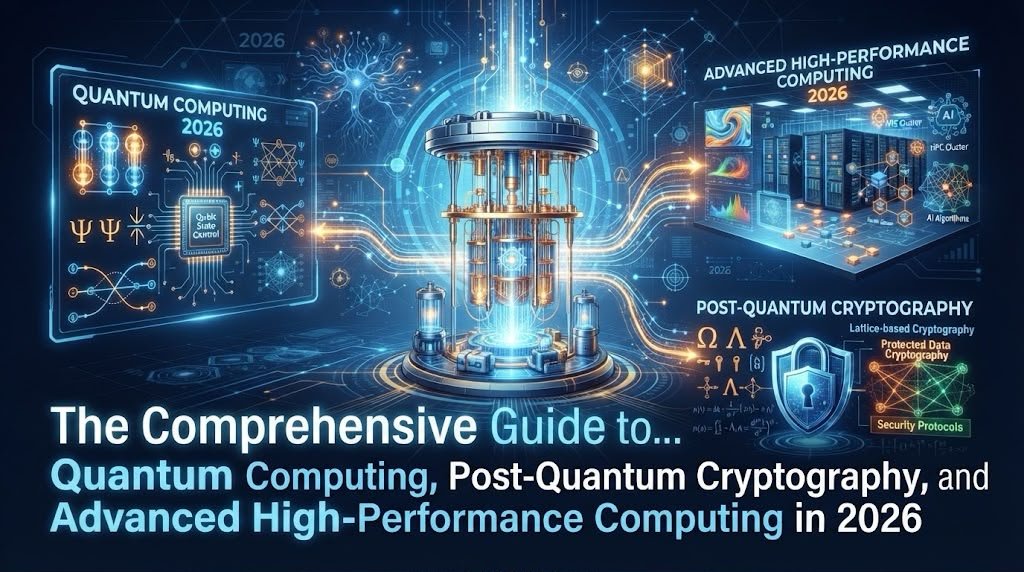
Classical silicon supercomputers, while incredibly fast, face fundamental physical bottlenecks when confronting high-dimensional optimization problems, molecular simulations, and complex cryptographic factorizations. Researchers and architects operating on Bytewisehub.site recognize that next-generation high-performance computing (HPC) relies on the seamless integration of classical CPU-GPU clusters with fault-tolerant quantum processors (QPUs). This convergence promises to solve computational challenges that would otherwise require millions of years of classical processing time in mere minutes.
The Shift from Noisy Intermediate-Scale Quantum (NISQ) to Fault-Tolerant Logical Qubits
For years, the quantum industry operated within the Noisy Intermediate-Scale Quantum (NISQ) era, where quantum states were highly vulnerable to environmental noise, thermal fluctuations, and decoherence. This error-suppression milestone allows quantum algorithms to execute deep, multi-gate computational circuits without losing data integrity, paving the way for reliable commercial scalability.
Hybrid Quantum-Classical Architectures in Enterprise Data Centers
Rather than replacing classical infrastructure entirely, modern quantum computing operates as an ultra-specialized co-processor within hybrid enterprise environments. Classical supercomputers handle data preprocessing, error decoding, and iterative loop management, while offloading high-dimensional matrix manipulations, superposition calculations, and complex probability distributions directly to the quantum processing unit.
2. Quantum Supremacy and Practical Algorithmic Advantage across Industries
Demonstrating quantum supremacy—performing a calculation on a quantum processor that is practically impossible for any classical supercomputer—has expanded from experimental physics benchmarks into tangible industrial applications.
Accelerating Material Science and Molecular Engineering
Simulating the exact quantum mechanical behavior of electrons in complex molecular structures has always overwhelmed classical computers because the computational complexity scales exponentially with the number of electrons. Quantum computers, operating natively on quantum mechanics, can simulate molecular interactions, catalyst behaviors, and novel polymer compounds with absolute fidelity, drastically accelerating material science breakthroughs.
Solving NP-Hard Global Logistics and Optimization Challenges
Global supply chains, airline scheduling networks, power grid load balancing, and financial portfolio optimization frequently involve NP-hard problems where the number of possible variables grows astronomically. Quantum annealing and gate-based quantum algorithms evaluate vast combinatorial solution spaces simultaneously through superposition, uncovering near-optimal logistical routes and financial hedging strategies instantly.
3. Post-Quantum Cryptography (PQC): Defending Against “Store Now, Decrypt Later” Attacks
While quantum computing promises revolutionary benefits, it poses a severe existential threat to modern cybersecurity infrastructure. Shor’s algorithm, running on a sufficiently powerful quantum computer, can efficiently break widely used asymmetric cryptography algorithms like RSA and Elliptic-Curve Cryptography (ECC).
The Threat of Harvest-Now, Decrypt-Later Cyber Espionage
Sophisticated nation-state threat groups are currently intercepting and storing encrypted enterprise communications, government secrets, and intellectual property over public networks.
NIST-Standardized Lattice-Based and Hash-Based Cryptographic Migration
To neutralize this impending threat, cybersecurity engineering teams in 2026 are actively executing global migrations to NIST-standardized Post-Quantum Cryptography (PQC) algorithms. These new cryptographic standards—primarily rooted in lattice-based mathematics and hash-based signatures—rely on complex mathematical problems that remain intractable for both classical and quantum computers alike, securing data for the decades ahead.
4. Quantum Key Distribution (QKD) and Unbreakable Network Encryption
In addition to mathematical post-quantum algorithms, quantum mechanics has a physical method of securing the transport of the data called Quantum Key Distribution (QKD).
The Laws of Quantum Mechanics as an Inviolable Security Shield
Quantum Key Distribution uses individual photons to transmit cryptographic keys between two parties. According to the Heisenberg uncertainty principle in quantum physics, any attempt by an eavesdropper to measure or intercept the photons alters their quantum state instantly. This perturbation introduces detectable transmission errors, immediately alerting communicating parties to the interception attempt and rendering the compromised key invalid.
Implementing Fiber-Optic and Satellite-Based QKD Networks
While range limitations and hardware costs remain challenging, QKD provides a mathematically absolute, physically unbreakable security layer for critical military communications, financial clearinghouses, and diplomatic networks.
5. Quantum Machine Learning (QML) and High-Dimensional Vector Spaces
The intersection of quantum computing and artificial intelligence—often termed Quantum Machine Learning (QML)—represents one of the most powerful computational integrations of our era.
Exponential Speedups in Feature Space Classification and Clustering
Machine learning models dealing with massive, high-dimensional datasets often struggle with the curse of dimensionality. Quantum algorithms can map classical data into vast quantum Hilbert spaces, performing pattern recognition, classification, and cluster analysis exponentially faster than classical neural networks through quantum parallelism and entanglement.
Enhancing Generative AI and Complex Optimization Workflows
Integrating QML into generative AI infrastructure allows models to process multi-modal parameters and simulate complex probabilistic distributions with unprecedented speed.
6. High-Performance Computing (HPC) Clusters and Exascale Architecture
Classical high-performance computing (HPC) has achieved the milestone of Exascale computing, capable of executing over a quintillion calculations per second.
Liquid Cooling, Dense Blade Servers, and Exascale Power Management
Powering exascale supercomputers requires massive engineering feats. Modern HPC facilities consume tens of megawatts of electricity, necessitating advanced closed-loop direct-to-chip liquid cooling systems, high-density blade server architectures, and dedicated renewable energy microgrids to prevent thermal runaway and maintain operational efficiency.
Message Passing Interface (MPI) and Distributed Parallel Processing
Exascale workloads rely on advanced Message Passing Interface (MPI) frameworks and parallel file systems to distribute heavy computations across hundreds of thousands of individual CPU and GPU nodes seamlessly. This distributed parallel processing underpins climate change modeling, nuclear fusion simulations, astrophysics data analysis, and advanced aerodynamic engineering.
7. Quantum Error Correction (QEC) and Surface Code Architectures
The greatest hurdle in scaling quantum computers has always been the extreme sensitivity of qubits to environmental noise, which causes decoherence and computational errors.
Physical Qubits versus Fault-Tolerant Logical Qubits
A single physical qubit is notoriously unstable. To achieve fault tolerance, modern quantum architectures use Quantum Error Correction (QEC) codes, such as surface codes, grouping hundreds or thousands of noisy physical qubits together into a single protected logical qubit.
Real-Time Syndrome Measurement and Active Error Suppression
Fault-tolerant quantum processors run continuous auxiliary syndrome measurements in the background of active computational circuits. When environmental interference threatens to flip a qubit state, active error suppression algorithms apply real-time phase and bit-flip corrections, preserving the integrity of long-running quantum algorithms without crashing the system.
8. Neuromorphic Supercomputing and Hybrid Biological-Silicon Systems
Parallel to quantum computing, neuromorphic engineering continues to push the boundaries of energy-efficient high-performance computing by emulating biological neural structures.
Asynchronous Event-Driven Architectures and Spiking Supercomputers
Neuromorphic supercomputers utilize millions of interconnected silicon artificial neurons that communicate via asynchronous spikes. Unlike traditional von Neumann processors that execute instructions on a rigid clock cycle, neuromorphic systems consume power only when active neuronal impulses occur, enabling massive cognitive processing power at a fraction of the electricity footprint.
Brain-Scale Simulations and Cognitive Computing Models
Neuromorphic HPC systems are deployed to run real-time brain-scale simulations, helping neuroscientists model cortical microcircuits, understand neurological disorders, and pioneer advanced cognitive robotics capable of biological learning and sensory adaptation.
9. Quantum Software Development Kits (SDKs) and Compilation Frameworks
Building algorithms for quantum hardware requires an entirely new paradigm of programming languages, abstraction layers, and compilation toolchains.
Translating High-Level Quantum Code into Physical QPU Gate Pulses
Quantum Software Development Kits (SDKs) allow developers to write quantum algorithms using high-level Python-based frameworks. Specialized quantum compilers then translate these logical gate operations into calibrated microwave pulses or laser frequencies that physically manipulate qubits inside the quantum dilution refrigerator.
Quantum Circuit Optimization and Noise Mitigation Toolchains
Because current quantum hardware remains sensitive, quantum compilation frameworks include automated circuit optimization passes that minimize gate counts, optimize qubit routing, and apply randomized compiling techniques to mitigate hardware noise errors before executing code on physical QPUs.
10. Commercialization and Cloud-Based Quantum-as-a-Service (QaaS) Platforms
Access to multi-million-dollar quantum hardware was once restricted exclusively to national research laboratories. Today, cloud-based Quantum-as-a-Service (QaaS) has democratized access.
Democratizing Quantum Research via Cloud API Endpoints
Major tech conglomerates and quantum startups now expose their quantum processors and simulators via secure cloud APIs. Enterprises, academic institutions, and independent developers can submit quantum circuits through standard web applications, running experiments on real superconducting or trapped-ion QPUs remotely.
Building Enterprise Quantum Readiness and Talent Ecosystems
Organizations are establishing dedicated quantum readiness programs, partnering with cloud providers to train software engineers in quantum algorithm design, linear algebra, and hybrid classical-quantum orchestration, ensuring they remain competitive as quantum commercialization accelerates.
Comparison of Modern High-Performance Computing Paradigms
| Computing Paradigm | Primary Hardware Technology | Key Operational Advantage | Primary Enterprise Use Case |
| Fault-Tolerant Quantum | Superconducting / Trapped-ion QPUs | Exponential speedup in high-dimensional math | Molecular simulation, cryptography, optimization |
| Exascale Supercomputing | Massive CPU-GPU parallel clusters | Quintillion-operations-per-second throughput | Climate modeling, astrophysics, aerodynamics |
| Neuromorphic HPC | Asynchronous spiking silicon | Extreme energy efficiency, brain emulation | Cognitive robotics, real-time pattern analysis |
| Hybrid Quantum-Classical | Integrated QPU + GPU clusters | Balances quantum power with classical control | Enterprise data analytics, combinatorial routing |
11. Comprehensive Quantum-Classical Middleware Integration and Heterogeneous Job Scheduling Frameworks
Integrating quantum processing units (QPUs) into traditional enterprise data center workflows requires sophisticated middleware and heterogeneous job scheduling frameworks. Because quantum computers excel at specific high-dimensional algebraic tasks while classical supercomputers handle control flow, input-output operations, and error decoding, modern high-performance computing centers deploy intelligent hybrid orchestrators. These platforms dynamically route computational sub-tasks across a diverse mix of classical CPUs, massive GPU clusters, and quantum processors based on real-time hardware availability, thermal constraints, and algorithm suitability. This seamless orchestration eliminates bottlenecks, ensuring that hybrid applications maximize throughput and operational efficiency across the entire computational stack.
Dynamic Task Offloading and Quantum Sub-Routine Compilation
Heterogeneous job schedulers analyze incoming codebases to identify which loops or matrix operations can benefit from quantum acceleration. Once identified, the middleware compiles those specific sub-routines into optimized quantum gate instructions while keeping the rest of the application running smoothly on classical hardware nodes, streamlining enterprise integration.
12. Advanced Quantum Annealing vs. Gate-Based Quantum Computing for Combinatorial Optimization
As quantum technology scales, two primary architectural paradigms dominate the landscape: Gate-Based Quantum Computing and Quantum Annealing. While gate-based systems use universal quantum circuits composed of qubits and logical gates capable of running any algorithm (such as Shor’s or Grover’s algorithms), quantum annealers are specialized analog systems engineered exclusively for solving complex combinatorial optimization problems. Quantum annealing operates by initializing a system in a superposition of all possible states and slowly evolving it to find the global minimum energy state, mapping directly to massive logistical routing, portfolio risk management, and traffic optimization problems with extreme efficiency.
Comparing Analog Quantum Annealing with Universal Gate-Based QPUs
Enterprise architects must carefully evaluate their specific computational workloads. While gate-based universal quantum computers offer broad versatility and are essential for fault-tolerant chemistry simulations and cryptography, quantum annealers provide a faster, highly practical path for solving massive discrete optimization and scheduling problems today without requiring complex error-corrected logical qubits.
13. Cryogenic Engineering and Ultra-Low Temperature Refrigeration in Quantum Infrastructure
Maintaining the delicate superposition states of superconducting qubits requires extreme physical environments that approach absolute zero. Quantum processors must operate inside sophisticated dilution refrigerators that cool hardware components down to millikelvin temperatures—colder than deep interstellar space. These multi-stage cryogenic systems use liquid helium isotopes (Helium-3 and Helium-4) to extract thermal energy continuously, preventing thermal fluctuations from disrupting quantum states and causing catastrophic decoherence. Designing and scaling these ultra-low temperature cryogenic enclosures represents one of the most demanding mechanical engineering feats in modern high-performance infrastructure.
Mitigating Thermal Noise and Managing Microwave Coaxial Cabling
Inside a dilution refrigerator, engineers must route hundreds of high-frequency microwave coaxial cables to control individual qubits. Managing thermal conduction down the temperature gradients from room temperature to millikelvin levels requires specialized attenuators, superconducting filters, and meticulous thermal anchoring to prevent outside heat from leaking into the quantum processor chamber.
14. Quantum-Resistant Public Key Infrastructures (PKI) and Enterprise Security Migration
The global transition from legacy asymmetric cryptography to NIST-standardized Post-Quantum Cryptography (PQC) requires a complete structural overhaul of enterprise Public Key Infrastructures (PKI). Organizations cannot simply swap out an algorithm overnight; they must inventory every digital certificate, cryptographic dependency, code-signing pipeline, and encrypted database across their entire global footprint. Enterprise security teams implement hybrid cryptographic certificates—combining traditional RSA/ECC algorithms with lattice-based post-quantum algorithms simultaneously—to ensure backward compatibility with legacy systems while securing data against active quantum interception threats during the multi-year migration window.
Cryptographic Agility and Automated Asset Discovery Frameworks
Successful PQC migration depends heavily on cryptographic agility—the architectural capability of a software system to swap underlying encryption algorithms dynamically without disrupting application functionality. Automated cryptographic discovery tools scan enterprise networks continuously to map every active key, certificate expiration date, and algorithm type, ensuring comprehensive compliance during the transition.
15. The Convergence of Exascale Supercomputing and Quantum Simulation for Climate Modeling
The ultimate test of modern high-performance computing lies in addressing humanity’s most complex planetary challenges, such as global climate modeling, weather prediction, and environmental sustainability. By merging exascale classical supercomputers with quantum simulation algorithms, researchers can model complex atmospheric fluid dynamics, ocean currents, and carbon cycle feedback loops with hyper-resolution accuracy. These hybrid HPC systems process petabytes of multi-modal satellite telemetry and meteorological data in real time, simulating localized climate shifts and extreme weather patterns years in advance to inform global disaster preparedness and renewable energy grid planning.
High-Resolution Earth System Modeling and Fluid Dynamics Simulations
Exascale systems use advanced parallel processing pipelines to simulate atmospheric physics down to the cloud-microphysics scale. When combined with quantum-accelerated fluid dynamics calculations, these models offer unprecedented predictive accuracy, helping scientists design resilient urban infrastructure and optimize global carbon sequestration strategies.
Frequently Asked Questions (FAQs)
Q1: How do hybrid quantum-classical middleware schedulers optimize performance?
A: Middleware schedulers analyze enterprise workloads and dynamically route sub-tasks across classical CPUs, GPUs, and quantum processors based on real-time hardware availability and algorithm requirements.
Q2: What is the key difference between Quantum Annealing and Gate-Based Quantum Computing?
A: Gate-based computing is a universal model capable of running any algorithm using quantum gates, whereas quantum annealing is a specialized analog method designed exclusively for solving combinatorial optimization problems.
Q3: Why are dilution refrigerators necessary for superconducting quantum computers?
A: Dilution refrigerators cool quantum processors down to extreme millikelvin temperatures (near absolute zero) using liquid helium isotopes to prevent thermal noise from destroying fragile qubit superpositions.
Q4: What is cryptographic agility and why is it vital for Post-Quantum Cryptography migration?
A: Cryptographic agility is an architecture’s ability to switch encryption algorithms dynamically without application disruption, which is essential for successfully migrating enterprise systems to post-quantum standards.
Q5: How do exascale supercomputers and quantum simulations aid climate modeling?
A: They combine massive classical parallel processing with quantum-accelerated fluid dynamics to model complex atmospheric physics and predict global climate shifts with hyper-resolution accuracy.
Conclusion: Navigating the Future Horizon of Quantum and High-Performance Computing
The technological ecosystem of 2026 clearly demonstrates that quantum computing and advanced high-performance supercomputing have matured into essential pillars of enterprise innovation and global security. By mastering hybrid middleware orchestration, cryogenic engineering, proactive post-quantum cryptographic migrations, and exascale climate modeling, organizations are positioning themselves to lead in a hyper-computed future. At Bytewisehub.site, we remain dedicated to tracking these monumental technological breakthroughs, providing deep technical insights to empower engineers, researchers, and technology leaders shaping the next era of global computing.