1. Comprehensive Evolution of Full-Stack Architecture and Modern Paradigms
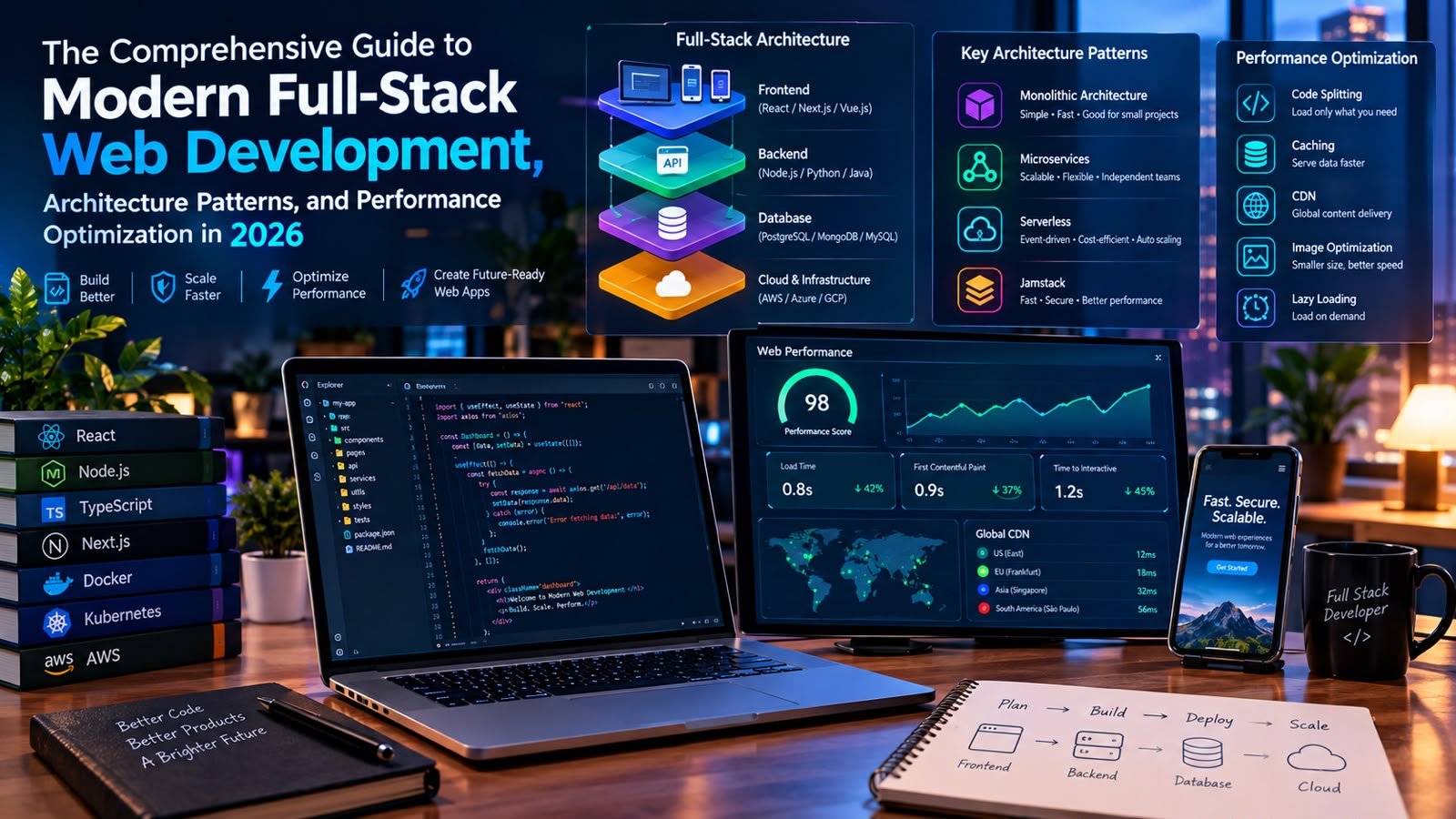
The landscape of web development has transformed dramatically over the years. Moving far beyond the traditional separation of static backend servers and rudimentary front-end rendering engines, modern web architecture in 2026 is defined by hyper-optimized, distributed, and fluid multi-tier systems. Developers on Bytewisehub.site recognize that today’s web applications must deliver instantaneous load times, seamless offline functionality, and scalable API-first communication.
The Shift from Monolithic Web Servers to Distributed Edge-Rendered Applications
Historically, web pages were entirely rendered on central monolithic servers, creating high latency and heavy loads during traffic surges. Modern web frameworks leverage hybrid rendering patterns—combining Static Site Generation (SSG), Incremental Static Regeneration (ISR), and Server-Side Rendering (SSR) directly at edge data centers. This ensures that users receive pre-optimized, lightning-fast HTML instantly, regardless of their geographic location relative to the core database.
The Rise of Component-Driven Design Systems and Modular UI Architecture
Modern full-stack engineering heavily relies on component-driven development. This architectural approach allows large engineering teams to work concurrently on different features without causing merge conflicts, ensuring consistent design language and rapid product iteration cycles across web and mobile platforms.
2. Modern Frontend Ecosystem: Frameworks, State Management, and Hydration Strategies
The frontend ecosystem has matured into a sophisticated engineering discipline characterized by advanced compilation tools, fine-grained reactivity, and intelligent hydration techniques.
Fine-Grained Reactivity and the Decline of Heavy Virtual DOMs
Early single-page application frameworks relied heavily on heavy virtual DOM diffing algorithms to update UI states. Modern frontend frameworks have shifted toward fine-grained reactivity, where DOM updates are tracked precisely at the variable level without re-rendering entire component trees.
Progressive Hydration and Server-Driven UI Components
To solve the performance bottleneck of downloading and executing massive JavaScript bundles on initial page load, modern frameworks use progressive hydration. Only the interactive components visible in the user’s viewport are hydrated initially, while non-critical sections remain lightweight HTML. Furthermore, Server-Driven UI (SDUI) patterns allow backends to dynamically dictate frontend layout structures, enabling instant feature updates without requiring users to download a new app version.
3. Backend Engineering: API-First Design, GraphQL, and gRPC Protocols
Backend architectures have evolved to support multi-platform clients—including web browsers, mobile apps, smart TVs, and IoT devices—requiring highly flexible and performant communication protocols.
Transitioning from RESTful Monoliths to Schema-Driven GraphQL and gRPC
While traditional REST APIs remain popular, modern enterprise systems frequently adopt GraphQL for client-driven data fetching and gRPC for high-throughput, low-latency microservice communication. gRPC uses Protocol Buffers and HTTP/2 transport to serialize data compactly, offering execution speeds up to ten times faster than traditional JSON-over-REST architectures.
Managing Asynchronous Event-Driven Messaging and WebSockets
Real-time web applications require continuous, bidirectional communication channels. Modern backend engineering integrates event brokers like Apache Kafka, RabbitMQ, and WebSockets to handle real-time chat, live collaboration tools, and live data streaming seamlessly, ensuring instant state synchronization across all connected clients.
4. Database Selection Strategies: SQL, NoSQL, and Vector Databases for AI Apps
Choosing the right data storage model is critical for application performance, data integrity, and scalability in modern full-stack engineering.
Balancing Relational ACID Compliance with Document Flexibility
Modern full-stack architects evaluate data access patterns meticulously. Relational databases with distributed SQL capabilities are chosen for applications requiring strict transactional integrity, while high-performance document stores handle flexible, semi-structured schemas. Additionally, the explosive growth of artificial intelligence has made vector databases indispensable for storing and querying high-dimensional embeddings used in semantic search and generative AI retrieval-augmented generation (RAG) pipelines.
Optimizing Query Performance and Indexing Strategies at Scale
As data volumes expand into terabytes, poorly optimized database queries can bring an entire application to a halt. Full-stack developers use advanced indexing, query caching layers (such as Redis), and database partitioning to ensure sub-millisecond read and write speeds, protecting application responsiveness under heavy enterprise loads.
5. Web Performance : Core Web Vitals
User conversion rates are directly tied to web performance. Search engines prioritize sites that excel in Core Web Vitals metrics.
Optimizing Largest Contentful Paint (LCP) and Cumulative Layout Shift (CLS)
Cumulative Layout Shift is minimized by explicitly sizing image and video containers, preventing annoying content jumps as asynchronous fonts and banners load into the viewport.
Code Splitting, Tree Shaking, and Advanced Asset Bundling
Modern bundlers use aggressive code splitting and tree shaking to eliminate dead code and break JavaScript bundles into micro-chunks. Only the exact code required for the current page route is downloaded by the browser, reducing initial payload sizes and accelerating time-to-interactive metrics.
6. Full-Stack Testing Methodologies: Unit, Integration, and End-to-End Automation
Maintaining high code quality across a complex full-stack application requires a comprehensive, automated testing strategy that catches bugs before they reach production.
Implementing Test-Driven Development and Comprehensive Unit Testing
Developers write isolated unit tests for business logic functions and UI components using modern testing frameworks. Test-driven development (TDD) ensures that code is written with testability and modularity in mind from the very beginning, drastically reducing unexpected side effects during refactoring.
End-to-End (E2E) Browser Automation and Visual Regression Testing
End-to-end testing frameworks simulate real user interactions—such as logging in, filling out checkout forms, and clicking navigation links—across multiple real browsers.
7. Modern CI/CD Workflows and Zero-Downtime Deployment Strategies
Deploying web applications safely without disrupting live users is a hallmark of mature full-stack engineering teams.
Automated Build Pipelines and Containerized Deployment Artifacts
Code changes merged into main branches automatically trigger comprehensive CI/CD pipelines that run test suites, build optimized container images, and push them to secure artifact registries. Immutable infrastructure patterns ensure that every deployment runs in a pristine, reproducible environment.
Implementing Blue-Green and Canary Rollouts for Safe Releases
Traffic is gradually shifted from the old application version to the new version while monitoring real-time error rates and performance metrics. If anomalies are detected, the system executes an instant automated rollback.
8. Web Security Best Practices: OWASP Top 10 Mitigation and Authentication
Securing full-stack web applications against malicious attacks is a non-negotiable requirement for protecting user data and organizational reputation.
Defending Against Injection Flaws, XSS, and Cross-Site Request Forgery
Full-stack developers implement robust input validation, parameterized database queries, and strict Content Security Policies (CSP) to neutralize common vulnerabilities outlined in the OWASP Top 10. Modern frameworks automatically escape rendered text to prevent cross-site scripting (XSS) attacks.
Implementing Modern Token-Based Authentication and Secure Session Management
Traditional cookie-based sessions have largely evolved into secure, encrypted JSON Web Tokens (JWT) or opaque session tokens handled via HttpOnly, Secure cookies. Multi-factor authentication, rate limiting on login endpoints, and strict authorization checks protect user accounts from credential stuffing and unauthorized access.
9. Progressive Web Apps (PWAs) and Offline-First Architecture
Bridging the gap between native mobile apps and web browsers, Progressive Web Apps deliver powerful offline capabilities and native-like performance.
Leveraging Service Workers and Client-Side Caching Strategies
Progressive Web Apps use background service workers to intercept network requests, cache critical static assets, and store dynamic data locally using IndexedDB. This enables applications to load instantly and function fully even when the user experiences intermittent network connectivity or total offline conditions.
Web Push Notifications and App-Like Engagement on the Web
PWAs support native features such as push notifications, home-screen installation prompts, and hardware device access, allowing businesses to engage users effectively without forcing them to download heavy applications from traditional mobile app stores.
10. Micro-Frontends and Monorepo Architecture for Large Engineering Teams
As web applications scale to hundreds of developers, monolithic frontend codebases become difficult to maintain. The industry has adopted micro-frontends and monorepos to solve this.
Decomposing Monolithic Frontends into Independent Micro-Apps
Similar to backend microservices, micro-frontend architecture splits a large web application into independent, decoupled micro-apps owned by separate cross-functional teams. Each micro-app can be developed, tested, and deployed independently while appearing as a unified seamless interface to the end user.
Managing Shared Code and Tooling with Advanced Monorepo Workspaces
Monorepo management tools allow large organizations to house multiple packages, micro-frontends, and backend services within a single version-controlled repository while efficiently managing shared dependencies, type definitions, and build caching.
Comparison of Modern Full-Stack Architectural Patterns
| Architecture Pattern | Primary Use Case | Key Operational Advantage | Scalability & Performance Profile |
| Edge-Rendered SSR | Global consumer web apps | Lightning-fast initial page loads, SEO optimization | High global scaling via CDN edge nodes |
| Micro-Frontends | Large enterprise web portals | Independent team deployments, modular maintenance | Excellent team velocity, moderate bundle coordination |
| Jamstack / Static SSG | Documentation, marketing sites | Maximum security, zero server maintenance | Instant static file caching, ultra-fast TTFB |
| Event-Driven Full-Stack | Real-time chat, dashboards | Bidirectional real-time sync, low latency | High concurrency handling via message brokers |
10. Micro-Frontends and Monorepo Architecture for Scaling Large Engineering Teams and Complex Web Applications
As modern enterprise web applications scale to hundreds of developers and millions of active users, monolithic frontend codebases inevitably become slow, brittle, and difficult to maintain. To resolve this architectural bottleneck, the industry has widely adopted micro-frontend design patterns and advanced monorepo workspaces. Similar to backend microservices, micro-frontend architecture decomposes a massive web application into independent, loosely coupled micro-apps owned by separate cross-functional feature teams. Each micro-app can be developed, independently tested, and autonomously deployed without risking the stability of the overall system. Furthermore, modern monorepo management tools allow large organizations to house multiple packages, shared design systems, and backend services within a single version-controlled repository while efficiently managing shared dependencies, type definitions, and incremental build caching.
Independent Deployment Lifecycles and Isolated Runtime Environments
The primary operational advantage of micro-frontends is the elimination of cross-team release coordination friction. In a legacy monolithic frontend, if two teams finish different features simultaneously, they must wait for a unified release window, leading to bottlenecks and potential regression bugs. With micro-frontends running inside isolated runtime environments—utilizing web components or module federation—Team A can deploy their checkout module updates instantly while Team B continues working on their user dashboard without interference.
11. Advanced State Management Strategies and Client-Side Data Caching in Distributed Web Applications
Managing complex application state across distributed full-stack architectures requires sophisticated architectural patterns that prevent synchronization bugs and reduce unnecessary network chatter. Modern web development moves away from bloated, global client-side state stores toward decentralized server-state synchronization tools and localized component states.
Decoupling Server Cache State from UI Local State Management
In modern web engineering, data fetched from remote APIs—such as user profiles, product catalogs, and transaction lists—is treated as remote server cache rather than traditional client application state. Specialized asynchronous data-fetching libraries handle background polling, optimistic UI updates, automatic cache invalidation, and deduplication of network requests transparently. This approach ensures that the local UI state remains lightweight, responsive, and strictly focused on handling user interactions like form inputs, modal toggles, and theme preferences.
12. Cross-Browser Compatibility, Accessibility (a11y), and Inclusive Web Design Standards
Building a truly exceptional web application requires ensuring that digital products are universally accessible to all users, regardless of their physical abilities, device types, or browser preferences. Inclusive web design and rigorous accessibility compliance are core pillars of modern engineering.
Implementing WCAG Guidelines and Semantic HTML Markup for Assistive Technologies
Modern full-stack developers prioritize semantic HTML markup and adhere strictly to Web Content Accessibility Guidelines (WCAG) to ensure seamless compatibility with screen readers, voice navigation tools, and keyboard-only control inputs. Automated accessibility testing is embedded directly into CI/CD pipelines, flagging missing alt tags, improper contrast ratios, and broken ARIA roles before code reaches production, thereby protecting organizations from legal liabilities and expanding their total addressable market.
13. Edge Computing Integration and Distributed Serverless Rendering Pipelines
The traditional model of routing every single browser request back to a centralized cloud data center introduces noticeable latency, especially for global audiences. Modern full-stack architecture solves this through deep integration with edge computing networks.
Executing Dynamic Middleware and Personalization at Global Edge Locations
Edge computing platforms allow developers to execute lightweight serverless functions and middleware directly at hundreds of data center points of presence (POPs) located mere miles from the end user. These edge nodes can handle JWT authentication verification, geo-based content localization, A/B testing variations, and header manipulation instantly in sub-milliseconds before the request ever touches the core application server, delivering an exceptionally fast and personalized user experience worldwide.
14. Real-Time Data Synchronization and WebSockets for Collaborative Enterprise Tools
Modern web applications increasingly demand real-time collaboration features—such as live document editing, interactive data dashboards, and multi-user chat systems—requiring robust, low-latency communication architectures.
Managing Persistent Bidirectional Connections and Conflict Resolution
Unlike traditional request-response HTTP cycles, real-time web applications rely on persistent WebSocket connections or Server-Sent Events (SSE) to enable instant bidirectional data flow. When multiple users modify the same data resource simultaneously, full-stack architectures utilize operational transformation algorithms or Conflict-free Replicated Data Types (CRDTs) to reconcile states automatically across clients, ensuring seamless real-time synchronization without data corruption.
Frequently Asked Questions (FAQs)
Q1: What is the primary benefit of adopting micro-frontend architecture?
A: Micro-frontends allow large engineering teams to develop, test, and deploy independent UI modules autonomously without waiting for centralized release cycles, drastically improving development velocity.
Q2: How does modern state management differentiate between server cache and UI state?
A: Modern applications treat remote API data as server cache handled by specialized asynchronous syncing libraries, keeping local UI state lightweight and focused strictly on immediate user interactions.
Q3: Why is accessibility (a11y) compliance critical in modern web development?
A: Accessibility compliance ensures that web applications are usable by individuals relying on assistive technologies like screen readers, while also improving SEO performance and expanding audience reach.
Q4: How do edge computing nodes accelerate full-stack web application performance?
A: Edge nodes execute dynamic middleware, routing, and personalization tasks geographically close to end users, eliminating high-latency round trips to centralized core cloud servers.
Q5: What mechanisms ensure data consistency in real-time collaborative web apps?
A: Real-time applications utilize persistent WebSocket connections combined with Conflict-free Replicated Data Types (CRDTs) or operational transformation algorithms to synchronize concurrent user modifications smoothly.
Conclusion: Navigating the Future Horizon of Full-Stack Web Engineering
The modern landscape of full-stack web development represents a remarkable convergence of high-performance edge rendering, micro-frontend scalability, robust API communication, and strict accessibility standards. By embracing component-driven design, intelligent client-side caching, and automated testing pipelines, engineering teams can build resilient web applications that delight users globally. At Bytewisehub.site, we remain committed to exploring these cutting-edge methodologies, providing deep technical insights to empower developers and technology leaders shaping the future of the digital web.